
Ammonites
Amethyst Aquamarine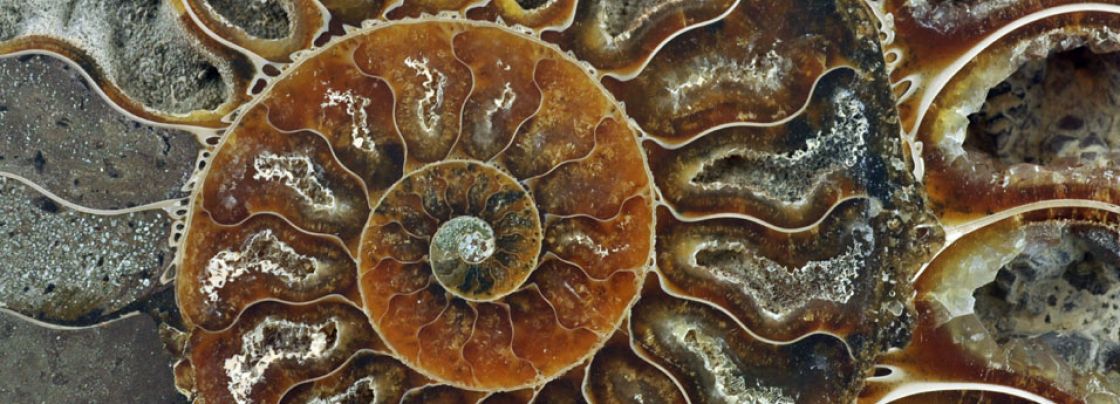
What are ammonites?
A fossil is a rock containing the preserved evidence of once living animals or plants. Fossils are found in sedimentary rocks (e.g., limestone, chalk and sandstone) as the fossil forms when the animal (or plant) is buried in sediment. Its soft parts rot away but any longer lasting hard parts will gradually be mineralised and turned to stone.
All ammonite species are long since extinct, their nearest equivalent today is the nautilus found in the Pacific Ocean. Ammonites swam in seas in many parts of the world and evolved over time into many variations of the basic pattern of a coiled shell. The smallest were about 1cm across right up to massive species reaching over 1m in diameter. Their era lasted from approximately 400 to 65 million years ago. This means that ammonites swam in seas when dinosaurs roamed the land.
Their shells were divided internally into chambers. By regulating the gas in the chambers, the ammonite could move up or down. It swam backwards, probably using jet propulsion(water forced through its 'mouth' at high pressure).
Most species lived in relatively shallow coastal waters at depths of 50-200m. The largest types probably lived in the warmer seas. They were carnivores, pulling food in with many 'arms' around their 'mouths'. The ammonite's body only occupied the final outer chamber of coiled shell.
Ammonite shells were made of aragonite. Some species show complex wavy or zigzag patterns on their outer shell. These are the edge of the walls (septa) which separate the many chambers – and are used in the classification of ammonite.
Palaeontologists are not entirely sure why ammonites, which once held a dominant position in our oceans, became extinct. They showed significant evolutionary change during their era and seemed capable of exploiting a range of ecological niches.
Sources
Crystals (UK) buys its ammonites from Madagascar, Morocco, Russia and Whitby, North Yorkshire. Our 'Open Me' ammonite pairs are generally prepared form North Yorkshire material by a fossil quarry owner's father.
Here at Crystals (UK) we have many, many stories to tell about ammonites. members of our team remember vividly the occasion of arriving in a Madagascan house in a tropical rainstorm. In low, or non-existent lighting conditions, while massive lightening flashed outside the window, we slowly realised the whole house was full of ammonites! The vendor's late husband had been a lifelong ammonite collector. We bought ammonites from very unusual locations that night including the bed linen drawer, all magnificently prepared, many with the stunning red flashes.
Ammonite fossils found in the Himalayas!
Fossils of marine animals discovered high on mountains throughout the world provide proof that those mountain rocks were formed under an ocean and later pushed up as continental (tectonic)plates collided.
Snakestones
In the north Yorkshire fishing town of Whitby (where some of our specimens come from), ammonites are called snakestones – legend tells of the town being plagued by snakes. Relief came when the town's Abbess Hilda turned them all to stone. (Presumably she encouraged them all to neatly coil up first!)
Hindu wedding presents
Ammonites washed out of Himalayan sedimentary rocks are prized by Indian Hindus who see them as symbols of the supreme Hindu god Vishnu. During wedding celebrations, an ammonite is presented by the bride's family to the bridegroom. It then becomes a central part of the household's prayers and traditional rituals.
Ammon the Sheep God
The coiled form of ammonites, being similar to the horns of some sheep breeds led to the choice of name for this fascinating and diverse group of animals.
Ammonite the film! In 2019, our Lyme Regis shop became part of the set for a film based loosely on the great 19th century palaeontologist Mary Anning who lived in Lyme Regis. Her major discoveries of many large sea creatures, then unknown to science, are now displayed in the Natural History Museum in London - including Ichthyosaur and Plesiosaur.
- Month stones
- January - Garnet also Ruby
- February - Amethyst also Bloodstone
- March - Aquamarine also Jade
- April - Quartz also Opal
- May - Rose Quartz also Agate
- June - Pearl also Moonstone
- July - Ruby also Carnelian
- August - Peridot also Sardonyx
- September - Iolite also Lapis Lazuli
- October - Opal also Pink Tourmaline
- November - Topaz also Citrine
- December - Turquoise also Tanzanite
- Zodiac Stones
- Capricorn (Dec 22-Jan 19) Amber, Carnelian, Garnet, Onyx, Smoky Quartz, Turquoise
- Aquarius (Jan 20-Feb 18) Aquamarine, Amethyst, Amber, Celestite, Fluorite, Labradorite
- Pisces (Feb 19-Mar 20) Moonstone, Amethyst, Aquamarine, Blue Lace Agate, Fluorite, Turquoise
- Aries (Mar 21-Apr 19) Ruby, Aventurine, Bloodstone, Carnelian, Garnet, Kunzite
- Taurus (Apr 20-May 20) Azurite, Kyanite, Lapis Lazuli, Malachite, Rhodonite, Tigers Eye
- Gemini (May 21-Jun 20) Chrysocolla, Citrine, Serpentine, Tourmalinated and Rutilated Quartz, Tiger's Eye
- Cancer (Jun 21-Jul 22) Moonstone, Pearl, Opal, Ruby, Moss Agate, Amber
- Leo (Jul 23-Aug 22) Tiger's Eye, Ruby, Carnelian, Kunzite, Larimar, Rhodocrosite.
- Virgo (Aug 23-Sep 22) Peridot, Amazonite, Citrine, Garnet, Moonstone, Opal
- Libra (Sep 23-Oct 22) Iolite, Opal, Kunzite, Lapis Lazuli, Moonstone, Peridot
- Scorpio (Oct 23-Nov 21) Topaz, Malachite, Charoite, Garnet, Obsidian
- Sagittarius (Nov 22-Dec 21) Turquoise, Amethyst, Labradorite, Sugilite, Topaz, Garnet
- There are a few stones that are suitable for every Zodiac sign: Moldavite, Tourmaline, Clear Quartz and Herkimer Diamond.