
Orthoceras
Opal Peridot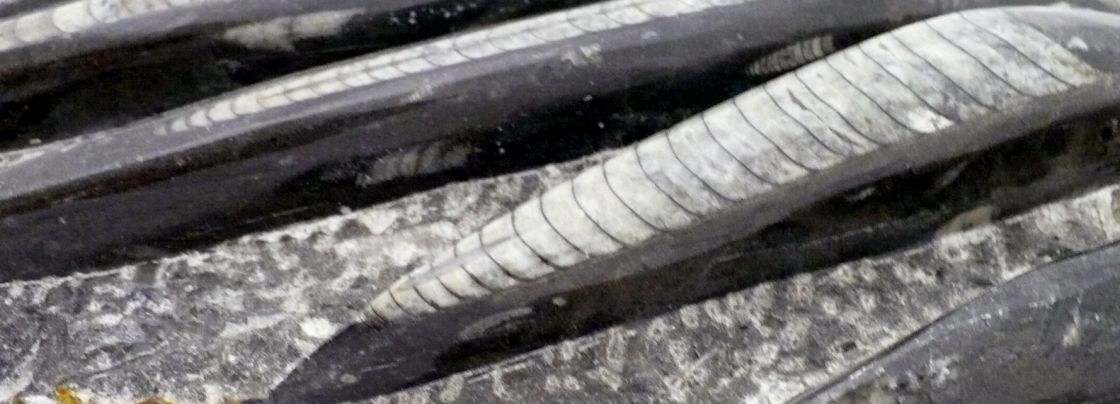
What is an orthoceras?
Orthoceras swam in many of the world's seas approximately 470 to 360 million years ago. Their modern counterparts are squid, octopus and cuttlefish. The word orthoceras means 'straight horn', referring to the characteristic long, straight, conical body. Although not curled like most ammonites, othoceras shared a similar internal structure of many chambers separated by walls, called septa. The soft body parts were contained in the open ended segment. These sea creatures are thought to have fed on plankton and small shelled species, grabbed by the tentacles.
Movement was dependant on the many chambered body - the animal could squirt water from its rear end to propel it forwards. By adding or removing fluid from the chambers (via the long connecting tube, the siphuncle) the animal could adjust its buoyancy and thereby swim at different depths. the siphuncle and septa lines are often clearly visible on orthaceras fossils. Sizes of these animals varied from a few centimetres in length to stunning specimens of several meters. After death, the bodies would settle on the sea floor, often currents would gradually align many in one direction as sediments started to cover them. Othoceras fossil beds, for example in Morocco, show that these areas were either once under the sea or have been raised by continental plate movements (or both!).
The name Pegoda Stone, which they are sometimes know by, arose due to the (slight) resemblance to Chinese Temples.
Our View
We have been offering thses wonderful fossils to our customers since the very early days of Crystals. They come from the High Atlas Mountains area of Morocco. Each plate represents a large number of hours of careful chipping and then polishing.
Many of our sales of the larger plates end up as striking natural sculptures in homes and gardens.
- Month stones
- January - Garnet also Ruby
- February - Amethyst also Bloodstone
- March - Aquamarine also Jade
- April - Quartz also Opal
- May - Rose Quartz also Agate
- June - Pearl also Moonstone
- July - Ruby also Carnelian
- August - Peridot also Sardonyx
- September - Iolite also Lapis Lazuli
- October - Opal also Pink Tourmaline
- November - Topaz also Citrine
- December - Turquoise also Tanzanite
- Zodiac Stones
- Capricorn (Dec 22-Jan 19) Amber, Carnelian, Garnet, Onyx, Smoky Quartz, Turquoise
- Aquarius (Jan 20-Feb 18) Aquamarine, Amethyst, Amber, Celestite, Fluorite, Labradorite
- Pisces (Feb 19-Mar 20) Moonstone, Amethyst, Aquamarine, Blue Lace Agate, Fluorite, Turquoise
- Aries (Mar 21-Apr 19) Ruby, Aventurine, Bloodstone, Carnelian, Garnet, Kunzite
- Taurus (Apr 20-May 20) Azurite, Kyanite, Lapis Lazuli, Malachite, Rhodonite, Tigers Eye
- Gemini (May 21-Jun 20) Chrysocolla, Citrine, Serpentine, Tourmalinated and Rutilated Quartz, Tiger's Eye
- Cancer (Jun 21-Jul 22) Moonstone, Pearl, Opal, Ruby, Moss Agate, Amber
- Leo (Jul 23-Aug 22) Tiger's Eye, Ruby, Carnelian, Kunzite, Larimar, Rhodocrosite.
- Virgo (Aug 23-Sep 22) Peridot, Amazonite, Citrine, Garnet, Moonstone, Opal
- Libra (Sep 23-Oct 22) Iolite, Opal, Kunzite, Lapis Lazuli, Moonstone, Peridot
- Scorpio (Oct 23-Nov 21) Topaz, Malachite, Charoite, Garnet, Obsidian
- Sagittarius (Nov 22-Dec 21) Turquoise, Amethyst, Labradorite, Sugilite, Topaz, Garnet
- There are a few stones that are suitable for every Zodiac sign: Moldavite, Tourmaline, Clear Quartz and Herkimer Diamond.